No Matter How Good the AI Tool Is
When AI tools first hit the mainstream, a lot of business owners assumed one thing would happen fast: prices would drop. The logic seemed obvious. If a machine can write, design, analyze, and automate without getting tired or asking for a raise, shouldn’t services built on AI cost a fraction of what they used to?
That assumption turned out to be one of the more expensive misconceptions in modern business. Companies that bought into it often ended up with underwhelming AI output, frustrated teams, and no idea why the tool that was supposed to save them money wasn’t paying off. Understanding why AI doesn’t replace human expertise is the key to avoiding that trap, especially if you’re making decisions about budgets, vendors, or hiring.
Key Takeaways
- AI doesn’t lower costs automatically. It lowers costs only when paired with people who know how to direct it.
- The “set it and forget it” idea of AI is a myth. Every useful AI output starts with human input.
- Prompt quality, system integration, and judgment calls are still human jobs, and they take real skill.
- Businesses that cut human expertise too aggressively after adopting AI usually see quality drop, not costs.
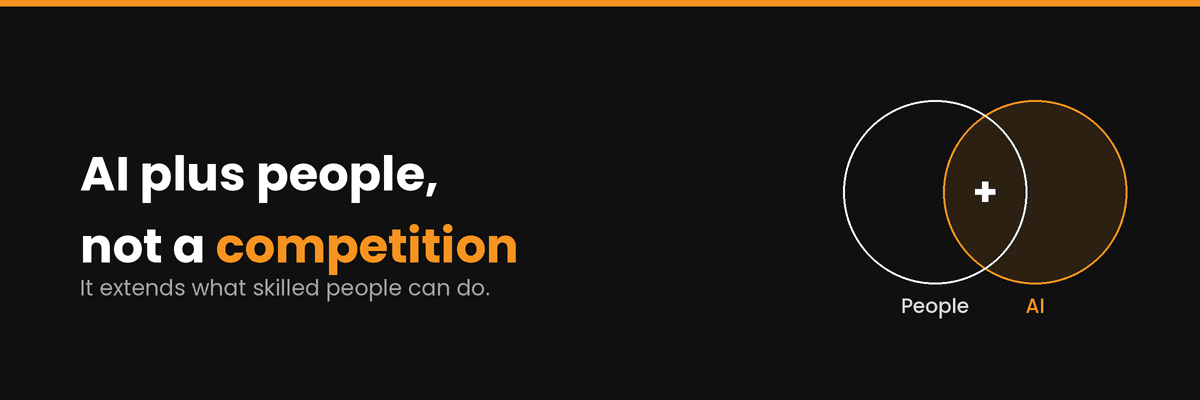
- The winning approach isn’t AI replacing people. It’s AI extending what skilled people can do.
What People Get Wrong When They Say AI Will Replace Human Expertise
At its core, the idea that AI could replace human expertise misunderstands what each one is actually good at, and where they fall short on their own.
AI is exceptional at processing large amounts of information quickly, spotting patterns, generating drafts, and handling repetitive tasks. What it isn’t good at is knowing your business context, your customer’s tone, your brand’s risk tolerance, or what “good” actually looks like for your specific goals. That gap is where human expertise still does the heavy lifting.
Why Did Everyone Expect AI to Lower Prices?
The expectation made sense on the surface. Early AI marketing leaned hard into words like “instant,” “automatic,” and “limitless.” If a tool can supposedly do the work of ten people, it’s natural to assume the price tag would shrink to match.
What got left out of that pitch was the labor still required to make AI useful. Someone has to write the prompts that get good results instead of generic ones. Someone has to connect the AI tool to your actual workflows, data, and systems. Someone has to review the output, catch the mistakes, and make sure it actually fits the task. None of that work disappeared. It just changed shape.
Why AI Doesn’t Replace Human Expertise
The Prompt Problem
A prompt is only as good as the person writing it. Two people can ask the same AI tool to “write a product description,” and get wildly different results, because one knows how to specify tone, audience, structure, and intent, and the other doesn’t. Getting consistently strong output from AI is its own skill, and it takes practice to develop.
The Integration Problem
AI tools rarely work in isolation. They need to be connected to your CRM, your content management system, your customer data, or your internal processes. That setup requires technical know-how that has nothing to do with the AI model itself and everything to do with how your business actually runs.
The Judgment Problem
AI doesn’t know when it’s wrong. It can generate a confident, well-formatted answer that’s factually off, tonally mismatched, or strategically misguided, and it will present that answer with the same confidence as a correct one. Catching that requires a human who understands the subject matter well enough to know when something’s off.
Practical Example: AI Without Expertise vs AI With Expertise
Picture two companies using the same AI writing tool to produce marketing content.
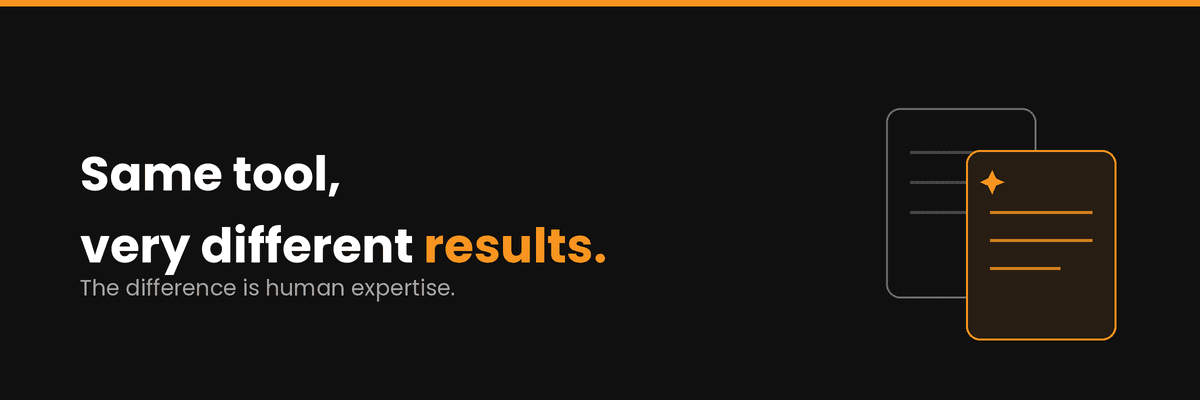
Company A hands the tool a one-line prompt and publishes whatever comes out. The content is generic, occasionally inaccurate, and doesn’t sound like their brand. They save time upfront but spend more later fixing customer confusion and weak engagement.
Company B uses the same tool, but a skilled marketer feeds it detailed prompts built around audience research, brand voice guidelines, and specific campaign goals. They edit the output, fact-check it, and refine it based on performance data. The AI didn’t replace the marketer. It made that marketer faster and more productive.
Same tool. Very different results. The difference is human expertise.
Best Practices for Combining AI and Human Expertise
Businesses that get real value from AI tend to follow a few consistent practices. They treat AI as a force multiplier for skilled employees, not a replacement for them. They invest in training people to write effective prompts rather than assuming the tool will figure out intent on its own. They build review processes so a human checks AI output before it reaches customers. And they keep refining their integrations as their needs change, instead of treating the initial setup as a one-time task.
Common Mistakes Businesses Make With AI Pricing Expectations
The most common mistake is assuming AI adoption should immediately shrink the budget for skilled labor. In practice, the budget often shifts rather than shrinks, moving away from repetitive manual tasks and toward strategy, prompt engineering, oversight, and integration work.
Another frequent mistake is cutting experienced staff too early, before anyone has confirmed the AI tool can handle their responsibilities without supervision. This usually backfires, since quality issues surface only after the damage to customer trust or output accuracy is already done.
A third mistake is treating every AI tool as plug-and-play. Most require ongoing tuning, fresh data, and human feedback loops to stay useful as the business evolves.
FAQs
Does AI actually make business operations cheaper?
It can, but usually through efficiency gains over time, not an instant price drop. The savings come from skilled people doing more with AI assistance, not from removing people altogether.
Why isn't AI as "automatic" as it's marketed to be?
Marketing often emphasizes speed and scale while leaving out the setup, prompting, and oversight that make AI output actually usable for a specific business.
Can a business use AI without any human expertise involved?
Technically yes, but the output quality is usually inconsistent, generic, or inaccurate without someone guiding and reviewing it.
What skills matter most for getting good results from AI?
Clear prompt writing, subject-matter knowledge to judge output quality, and technical familiarity with how to integrate AI into existing workflows.
Will AI eventually need less human oversight?
Tools are improving, but judgment calls tied to context, brand, and strategy are likely to stay a human responsibility for the foreseeable future.
Is it a mistake to reduce staff after adopting AI tools?
Cutting staff before confirming AI can reliably handle the work without supervision is a common and costly mistake.
Conclusion
The idea that AI should have made everything cheaper overnight was always an oversimplification. Why AI doesn’t replace human expertise comes down to one fact: it’s a partnership, not a competition. AI handles scale and speed. People handle direction, judgment, and the context that makes the output actually useful.
If you’re evaluating AI tools for your business, the smartest move isn’t asking how many people you can replace. It’s asking how to pair the right tool with the right expertise, so you get output that’s not just fast, but actually good.