Every couple of years, someone announces that web development is dead. In 2026 the claim is louder than usual, and it is easy to see why. AI can now turn a sentence into working code. No-code tools can launch a real website in an afternoon. Type a prompt into an AI builder and a landing page appears.
So the question is fair. If you build websites for a living, or you are thinking about learning, is this still a smart place to put your time?
Short answer: no, web development is not dying. It is changing, and the change is worth understanding. Here is what is actually happening, without the hype.
Key takeaways
- Web development is evolving, not disappearing. The job is moving up the stack.
- AI writes code, but someone still has to design, review, secure, and ship it.
- No-code handles the simple work well, then breaks on the custom parts businesses actually need.
- The data points up: steady job growth, strong pay, and a global shortage of tech talent.
- The developers and agencies who use AI as a tool are pulling ahead of the ones who ignore it.
Why people think web development is dying
Three real shifts are behind the fear, and none of them are just marketing.
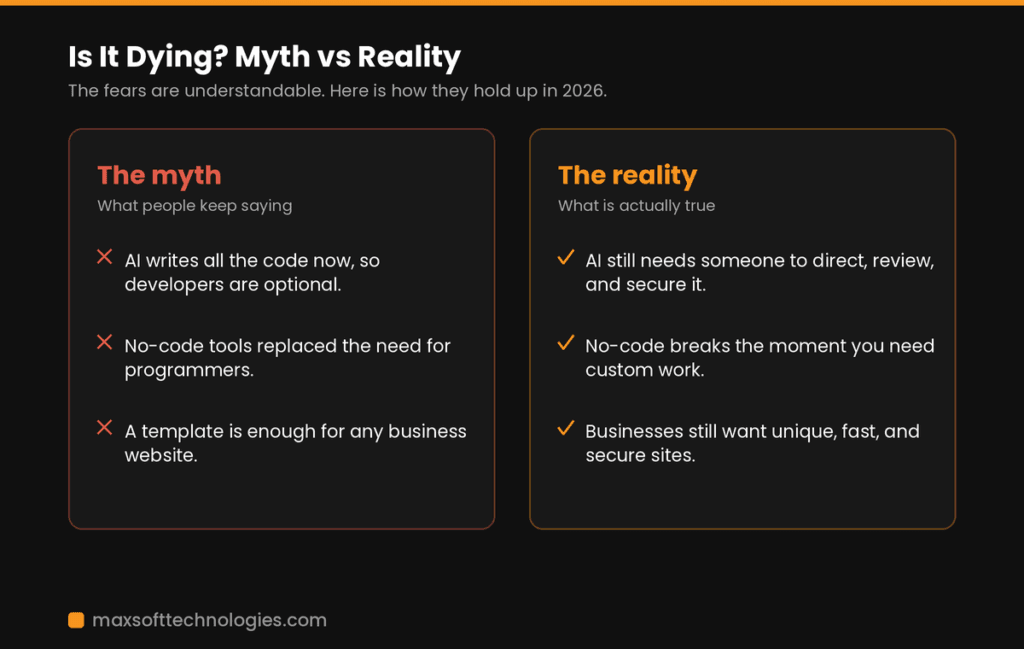
First, AI coding assistants. Tools like GitHub Copilot, Cursor, and prompt-to-app builders generate working code quickly. From the outside, it looks like the developer is being written out of the process.
Second, no-code and low-code platforms. Webflow, Framer, Bubble, and Shopify let people with no coding background build sites and stores that actually function.
Third, AI website builders. For a simple brochure site, a prompt and a few edits can be enough.
These are genuine changes. Pretending they do not exist is the fastest way to fall behind. But “faster to start” is not the same as “no longer needed,” and that gap is the whole point.
Why web development is not going anywhere
AI writes code, but it does not own the outcome. Someone still has to decide the architecture, connect the moving parts, review what the AI produced, catch the security holes, and make the whole thing fast. Think of AI as a very capable junior teammate that never doubts its own work. Directing that teammate is exactly the job a skilled developer does.
No-code covers the easy 80 percent, then hits a wall on the 20 percent that matters. The moment a business needs a custom integration, a specific checkout flow, a tricky data setup, or real performance at scale, someone has to go under the hood. That is where a lot of no-code projects quietly bring in a developer.
Every business wants to look and work a little differently. Templates get you to “fine.” Standing out, converting visitors, and matching a real brand still takes custom work.
And the hard parts are still human. Performance, security, accessibility, SEO done properly, and clean integrations with the tools a company already runs all take judgment that tools cannot fake.
What has actually changed, and what to do about it
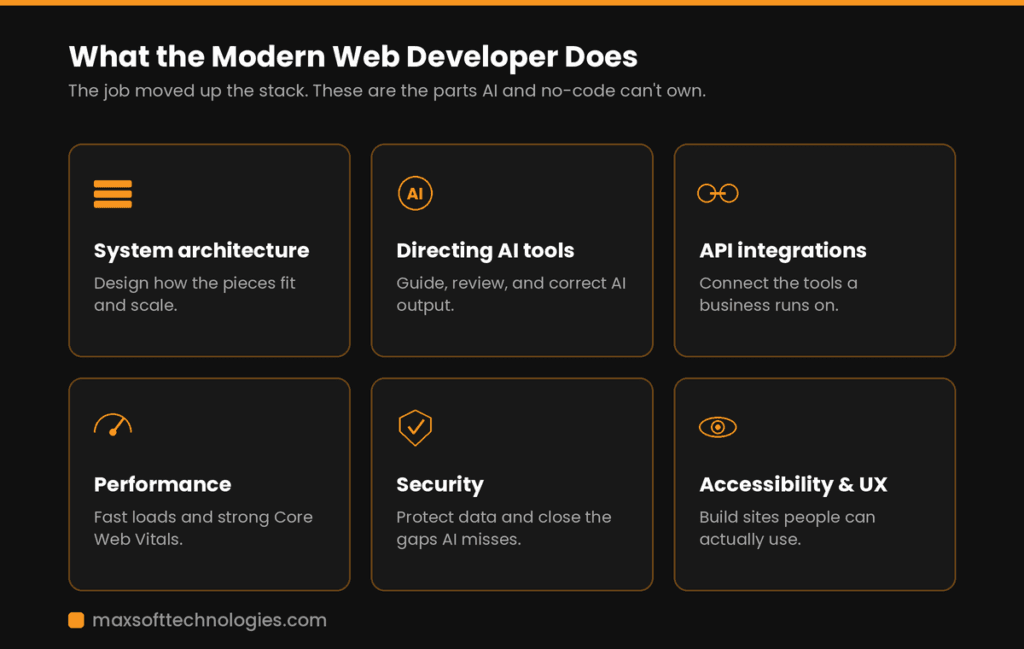
The role is moving up the stack. Less time typing boilerplate, more time on the decisions that shape a project:
- System design and architecture
- Reviewing and directing AI output instead of writing every line by hand
- API and third-party integrations
- Performance, Core Web Vitals, and security
- Turning business goals into the right technical choices
If you build websites, the smart move is to treat AI as leverage rather than a threat. Developers who pair strong fundamentals with AI tools ship more, not less. The ones who refuse to touch the tools are the ones who will feel squeezed.
The data says web development is alive
The “it’s dying” story does not match the numbers.
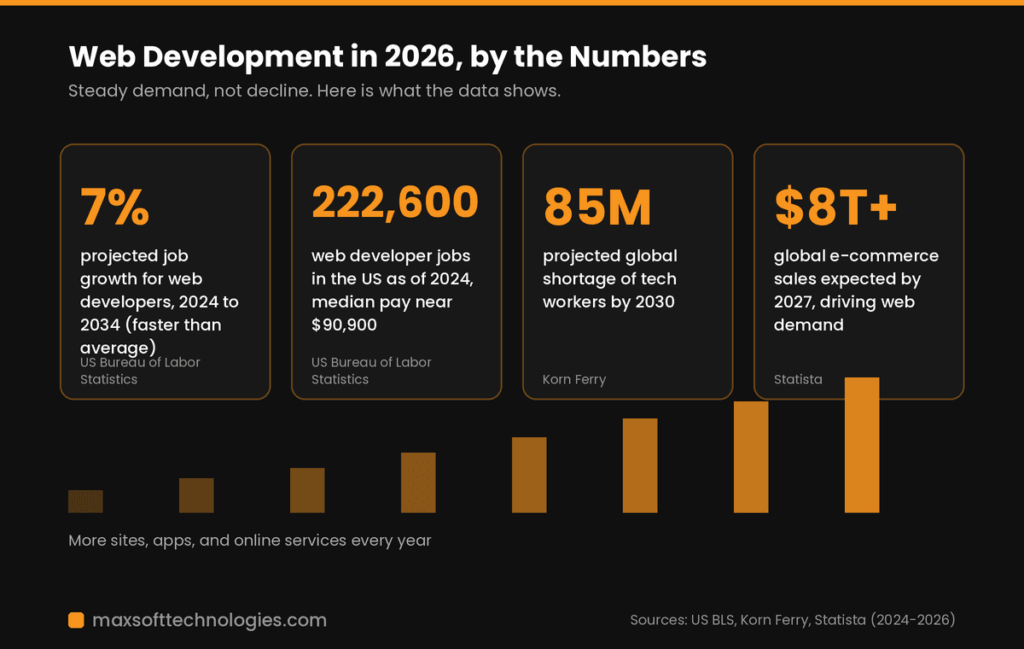
The US Bureau of Labor Statistics projects employment of web developers and digital designers to grow 7 percent from 2024 to 2034, faster than the average for all occupations, with roughly 14,500 openings a year. As of 2024, there were around 222,600 web developer jobs in the US, with median pay near $90,900. Zoom out to computer and IT occupations as a whole and the outlook is stronger still, with a median wage close to $106,000 and much faster than average growth.
Demand is not slowing on the business side either. Global e-commerce sales are expected to pass $8 trillion by 2027, and every one of those storefronts needs someone to build and maintain it. Meanwhile, the global shortage of tech talent could reach around 85 million unfilled roles by 2030.
Growth is steady rather than explosive, and AI is part of the reason. Each developer is more productive than before, so fewer people are needed per task. But that is happening at the same time the world is building more websites, apps, and online services than ever. The net result is a healthy field, not a dying one.
What this means for your business
If you run a business, the takeaway is simple. You still need people who can build and maintain a site properly. What changed is that a good team now delivers faster and at lower cost than a few years ago, because AI handles the repetitive work while experienced developers handle the thinking.
So the question is not whether to hire developers. It is who to hire. The agencies and developers worth your budget are the ones using AI to move faster without cutting corners, not the ones charging you to publish a template and calling it a custom site.
The verdict
Web development is not dying. The old version of it, where every line was hand-written from scratch, is fading, and that is a good thing. What is growing is a smarter version of the job: developers who design systems, direct AI, and solve the problems tools cannot.
If you are learning, keep going, and learn the AI tools alongside the fundamentals. If you are hiring, look for people who think, not just people who type.
FAQs
Not in any realistic near term. AI speeds up coding, but it still needs a skilled person to plan the architecture, review the output, handle security, and connect everything to real systems.
Yes. Job growth is steady, pay is strong, and demand is broad across industries. Learn the fundamentals and the AI tools together and you will be in a good spot.
For a very simple site, sometimes. For anything with custom features, integrations, or serious performance and security needs, you will still want a developer involved.
System design, directing and reviewing AI, API integrations, performance, security, and accessibility. The value has shifted from typing code to making good technical decisions.
Looking for a website built by a team that uses AI to move faster without cutting corners? That is what we do at MaXsoft.